
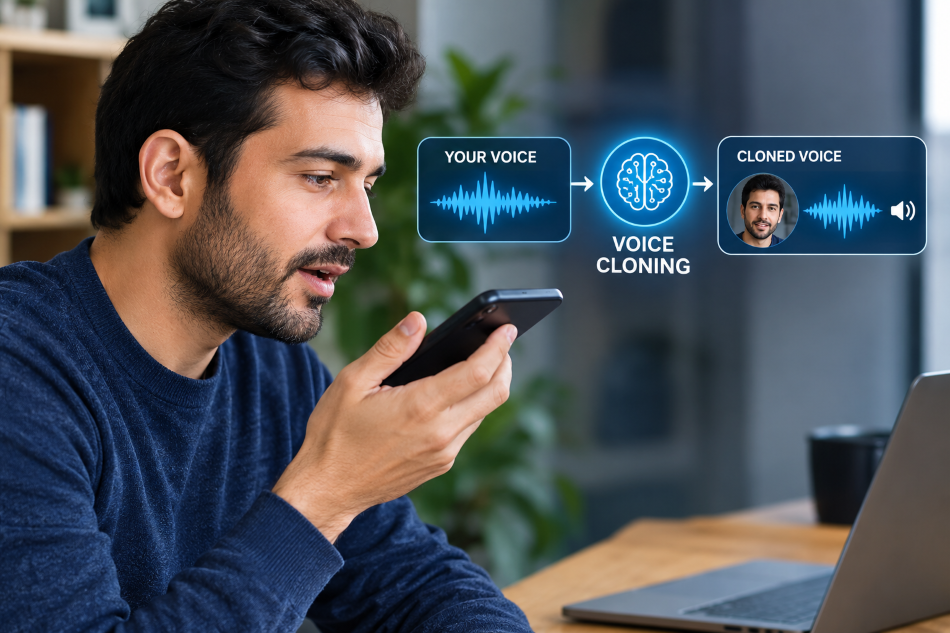
Imagine receiving a phone call from your son, daughter, grandson, or another loved one. the voice sounds exactly like them. they are frightened and speaking quickly. they tell you they have been arrested, injured, stranded, or involved in an accident. then comes the urgent request: “dad, i need help. please send money right now.”
you would probably want to help immediately. that is exactly what scammers are counting on.
welcome to the world of voice cloning scams, where artificial intelligence can be used to imitate someone’s voice and make a fake emergency sound frighteningly real. the federal trade commission (ftc) has warned that scammers can use ai voice-cloning technology in family emergency scams, sometimes using only a short audio recording of a person’s voice.
what is a voice cloning scam?
voice cloning is technology that can create an artificial version of a person’s voice. modern ai systems can analyze recorded speech and reproduce characteristics such as tone, rhythm and pronunciation. the technology has legitimate uses, including accessibility and medical applications, but criminals can misuse it for fraud.
in a typical voice cloning scam, criminals obtain a recording of someone’s voice from social media videos, online interviews, podcasts, videos, or other publicly available material. they can then create convincing artificial speech and use it to impersonate that person.
the victim may hear what sounds like a familiar family member asking for urgent assistance. the voice itself becomes the scammer’s most powerful weapon.
how the “dad, i need help” scam works
the scam usually follows a predictable pattern.
first, you receive an unexpected call. the caller sounds like your child or grandchild.
next, the caller describes a frightening situation. perhaps they claim they have been arrested after an accident, lost their wallet while travelling, been hospitalized, or are facing some other emergency.
then they create urgency. you may hear statements such as “i need the money immediately” or “please don’t tell anyone.”
finally, they provide instructions for payment. scammers may request a bank transfer, cryptocurrency, gift cards, cash, or a payment through a money-transfer or payment app. the ftc specifically warns that family-emergency scammers often demand payment methods that are difficult to reverse.
the entire story is designed to prevent you from thinking clearly.
why the scam is so convincing
traditional scams often depend on pretending to be someone you know. voice cloning makes that deception much more believable.
when you hear a familiar voice saying “dad” or “mom,” your natural emotional reaction may override your logical thinking. fear takes over. you want to protect your family member first and investigate later.
scammers understand this psychological weakness. they deliberately create panic, urgency and secrecy.
the caller may say that there is no time to explain. they may claim their phone is broken, they are using someone else’s phone, or they cannot speak freely.
they may even provide personal information about you or your family to make the story sound authentic. such information can sometimes be gathered from social media, data breaches, hacked accounts or other publicly available sources.
the most important rule: don’t trust the voice alone
this is the single most important lesson.
a familiar voice is no longer proof of identity.
even if the voice sounds exactly like your son, daughter or grandchild, stop before sending money.
the ftc recommends independently verifying the situation rather than trusting the incoming call.
hang up and call your family member using a telephone number already stored in your contacts. do not use a number supplied by the caller.
if they do not answer, contact another family member or trusted friend who can verify what is happening.
create a family secret word
one practical way to protect your family is to establish a secret word or phrase.
choose something that is difficult for outsiders to guess but easy for your family to remember.
for example, if someone calls claiming to be your child and asks for emergency money, ask for the family password.
do not use an obvious word such as a pet’s name or birthday, particularly if that information appears on social media.
a secret phrase should never be posted publicly or shared with strangers.
don’t let the caller rush you
urgency is one of the strongest warning signs.
a legitimate family emergency may require quick action, but that does not mean you must send money within minutes.
tell the caller:
“i want to help, but i need to verify this first.”
a genuine family member should understand your concern. a scammer may become angry, threatening or increasingly desperate.
that emotional pressure is itself a warning sign.
watch for secrecy
scammers frequently tell victims not to contact anyone else.
they might say:
“don’t tell mom.”
“don’t call the police.”
“don’t tell anyone at work.”
“please keep this between us.”
this is designed to isolate you from people who might recognize the fraud.
the ftc warns that secrecy combined with urgency is a common feature of family emergency scams.
if someone tells you not to verify their story, do the opposite.
be suspicious of unusual payment requests
another major warning sign is an unusual payment method.
scammers may request gift cards, cryptocurrency, wire transfers or other difficult-to-recover forms of payment.
never assume that a payment request is genuine simply because the caller sounds familiar.
if someone says they need thousands of dollars immediately, stop and independently verify the situation.
protect your voice online
you do not have to disappear from the internet to reduce your risk.
however, think carefully about how much voice material you make publicly available.
avoid posting unnecessary long recordings containing clear, uninterrupted speech. review privacy settings on social media accounts and limit access to personal information where practical.
also be careful about publicly sharing details such as travel plans, family relationships, birthdays, addresses and other information that scammers could combine with a voice recording to make an impersonation more convincing.
what parents and grandparents should do
older adults are often targeted by family-emergency scams because criminals know that parents and grandparents may react immediately when they believe a loved one is in danger.
families should discuss this threat before an emergency happens.
tell parents and grandparents:
“if you ever receive a call saying i am in trouble and need money, hang up and call me directly.”
having this conversation in advance can make an enormous difference.
the goal is to replace panic with a predetermined procedure.
what to do if you receive a suspicious call
if you receive a call claiming to be a loved one in trouble:
- stay calm and do not send money immediately.
- hang up or tell the caller you will call back.
- call the loved one using a trusted number already in your contacts.
- contact another family member if you cannot reach them.
- do not follow payment instructions given by the suspicious caller.
- save relevant messages, telephone numbers and transaction information.
- contact your bank or payment provider immediately if you have already sent money.
- report the fraud to the appropriate authorities.
the sooner you act after sending money, the better your chances may be of limiting further loss.
what if the voice sounds absolutely perfect?
this is where many people make a dangerous mistake.
they think, “i know my son’s voice. there is no way this could be fake.”
unfortunately, that assumption is no longer safe.
the technology behind voice cloning has become increasingly sophisticated, and the ftc has acknowledged that cloned voices can be difficult to distinguish by ear.
instead of asking, “does this sound like my child?” ask:
“how can i independently prove that this really is my child?”
that change in thinking can protect you.
don’t rely on ai detection alone
technology companies and researchers are developing methods to identify synthetic audio, but consumers should not assume that a detection tool will always identify a fake voice.
voice-cloning technology continues to evolve, and detection methods also have limitations.
your strongest protection remains independent verification.
call the person directly. contact another trusted person. verify the emergency through a separate communication channel.
if you have already sent money
do not be embarrassed and do not wait.
contact your bank, card company, payment provider or money-transfer service immediately and explain that you believe you were defrauded.
provide transaction details and ask what recovery or cancellation options are available.
save screenshots, phone numbers, messages, emails and receipts.
also report the scam to the relevant law-enforcement or consumer-protection authority. in the united states, the ftc directs consumers to report fraud through reportfraud.ftc.gov.
if you are outside the united states, contact your country’s appropriate cybercrime or consumer-protection authority.
five words to remember: stop, hang up, verify
you do not need to become an artificial intelligence expert to defend yourself.
remember five simple actions:
stop.
don’t react emotionally.
hang up.
don’t allow the scammer to control the conversation.
verify.
call the person using a trusted number.
tell someone.
another family member can provide an independent check.
then act.
only after verification should you decide what needs to be done.
conclusion
voice cloning scams exploit something deeply human: our love for family.
a scammer does not need to break into your home when they can simply create a convincing version of your child’s voice and make you believe that your loved one is in danger.
the most important protection is not sophisticated software. it is a pause.
when someone who sounds exactly like your son, daughter, grandchild or friend suddenly says, “dad, i need help,” don’t panic and don’t send money immediately.
hang up. call them back on a trusted number. contact another family member. verify the emergency independently.
technology may make a scammer’s voice sound real, but verification can reveal the truth.
in the age of ai, never let a familiar voice become your proof of identity.